Blanca's Story
#ShareBecauseYouCare
A true story of the power of compassion, humility, empathy and the human spirit.
My parents divorced when I was 21, after a 20-year marriage. Mom passed away from cervical cancer about a year later, in 1986. This was a devastating loss and a very difficult adjustment for my siblings and me. A lot transpired between then and the time that Blanca came into our lives, but the gist of it is that Dad was rebuilding his own life. The relationship with us kids became strained, if not disconnected. It didn’t help that I was living on the East Coast, my siblings were in Northern Nevada, and dad was in Southern Nevada.
Fast forward to the late ’90s in Mesquite, Nevada. After decades in many prestigious positions in the casino industry, Dad left the casino industry (that’s another story) and ended up getting a job as an assistant manager at the McDonald’s restaurant in Mesquite. I believe his fluency in Spanish from spending many years of his childhood in Mexico City helped him land the job, since most of the workers in the back of the house were Hispanic and spoke very little English.
Blanca was one of those workers. She and Dad had an instant connection and eventually became inseparable as a couple. Within a short time, Dad had put in the work to reconnect with us kids. He told us all about Blanca and how happy he was. They eventually came out to Pennsylvania to stay with me, my husband and toddler son for a few months. During their stay, I got to know Blanca well—mostly with Dad helping to interpret, but also through some conversations we had with her limited English and my attempts at speaking and understanding some limited Spanish.
I found out then that she had urged Dad to reconnect with family, because “Vida es demasiado corta” (life is too short). She was determined to be helpful during their stay with us and never asked for anything. She told me that her mission in life was to do something kind for another human being every day she was on this earth. She honored that mantra religiously.
Dad and Blanca would visit again several times throughout the years with their motor home. I loved that time we spent together. Blanca was such a joy to be around, and I loved hearing about her life and how she ended up in the United States. From the many conversations we had over the years, I want to share her story.
Blanca had family in Mexico City and in Cuernavaca, Mexico. She shared that she had been in a tragic bus accident in the hills of central Mexico—perhaps on her way to visit family. The accident resulted in mass casualties. She was one of the very few survivors, possibly the sole survivor. I believe that the combination of her deep, painful physical and emotional trauma from that accident, the need to help her family out financially and her inability to find gainful employment in Mexico led her to seek a change. The painful memories of this along with a failed marriage helped push her to leave her country and move to the United States.
Thanks to a contact and sponsor willing to provide Blanca with employment in Mesquite, Nevada, she was able to get a limited work visa to come to the United States. She completed all the necessary paperwork to get the job at McDonald’s, which included having the appropriate taxes and Social Security taken out. She was told that she would not be eligible to receive future Social Security or other benefits for any work she did as a non-citizen. When she met dad, she asked him to help her seek a residency visa and eventually a path to citizenship. They worked together with an immigration representative, filled out all the required, repetitive, and tedious paperwork and spent thousands of dollars as they navigated the process as it existed.
During this lengthy process, they got married. At some point, Blanca’s work visa expired, and she was faced with the possibility of deportation at any time, despite being married to an American citizen. She was ultimately allowed to stay in the United States as long as she checked in frequently with immigration, but she was flagged as an “undocumented worker”—or what many today now (sadly) refer to as an “illegal alien”.
Blanca was a devout Catholic and always carried rosary beads that were blessed by the Pope. I still cannot grasp how the most humble, hardworking, God-fearing, and kind human being I ever met could be seen as “illegal”. I believe that after all the years of trying to get Blanca permanent residency and spending every penny they had after living expenses, she was finally granted some sort of longer-term resident or work visa, and she eventually became a proud citizen of these United States.
Not long after she became a citizen, Blanca was on her way to the bathroom at the RV Park they were staying at when she came upon one of the park workers struggling to carry her cleaning supplies into the bathroom. Blanca, maintaining her life’s mantra, stopped to assist her, and as she was carrying some of the supplies for the worker, Blanca collapsed. She was flown to a trauma center in Las Vegas, where it was determined she had a brain bleed from an aneurysm, likely the remnants of the tragic accident years before in Mexico. She had emergency surgery, but after 9 days she lost the fight, and she passed away with dad, her son, and her sister (flown in from Mexico) by her side.
True to form, Blanca had spent her final waking moments helping another human being that she didn’t even know. Even in death, she was able to help others since she was an organ donor. Her corneas gave the gift of sight to two people in San Diego, California.
Dad remained connected to us kids and often told me that he was the luckiest man on earth. In the months before he passed away, he made it a point to tell me, “I have no regrets in this life. I was lucky to be with two soulmates—your mother, my first love, and then Blanca, my angel.” I replied, as I held his hand, “Dad, we loved mom so much, and Blanca was the angel of our family. I am so glad she came into our lives.”
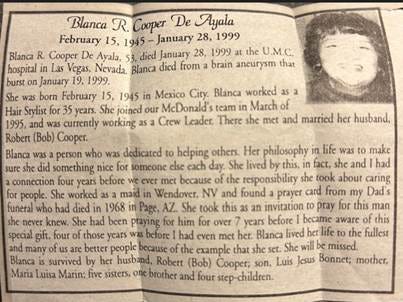
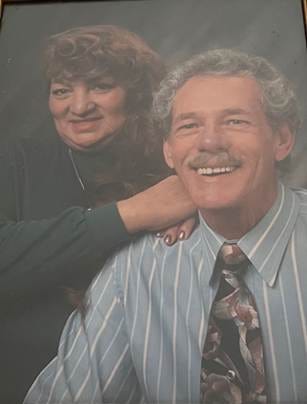
The article below was written by the manager of McDonald’s in Mesquite, shortly after Blanca’s passing. This is another example of the profound and loving impact she had on many lives while living in the United States.
Epilogue
Most undocumented immigrants are honest, hard-working people who are simply looking for a better life than the circumstances that brought them here—some escaping violence, others trauma, and some seeking opportunities they can’t find in their home countries.
The complicated and bureaucratic process to seek entry legally, or even to get a work visa, is what compels those who are desperate to cross into the country illegally, but the vast majority of those do turn themselves into immigration and start the process of seeking asylum. They get jobs, contribute to the economy—their Social Security payments help fund the program even though they will not be eligible for any of those benefits they are paying into—and a very low percentage of these immigrants commit crimes when here.
Unfortunately, the bad eggs and propaganda have made even the “Blancas” and their families living among us the enemy to a large portion of Americans. My hope is that the points below will help clear up many misconceptions and we can all take a step back and think about a humane, compassionate solution for the border problem versus mass deportations that have already begun and have not been focused solely on those who have committed crimes. Not only have undocumented workers like Blanca been detained, but even American citizens, including a veteran, have been affected.[1]
Workforce Participation & Economic Contributions:
The vast majority (96.7%) of Mexican undocumented workers are working and contributing to the economy and are vital to critical American industries including agriculture (11.5 percent of the workforce), construction (6.7 percent), and the tourism and hospitality sector (3.4 percent).
Given their productivity and their numbers, Mexican undocumented immigrants are significant economic contributors to the American economy. In 2019 alone, they earned almost $92 billion in household income and contributed almost $9.8 billion in federal, state, and local taxes. Mexican undocumented immigrants held more than $82.2 billion in spending power, money that often goes back into local economies as they spend on housing, consumer goods, and services. [2]
Crime Statistics: Studies have shown that undocumented immigrants are less likely to commit crimes than native-born citizens. According to a 2018 study by the Cato Institute, undocumented immigrants have lower incarceration rates compared to native-born Americans.[3]
Asylum Seekers: Many undocumented immigrants turn themselves into immigration authorities to seek asylum and safety for them and their families from violence, trauma or prosecution. They go through a legal process to gain protection and eventually work towards legal status. Asylum seekers and refugees must demonstrate a well-founded fear of persecution based on race, religion, nationality, membership in a particular social group, or political opinion. Both statuses play a critical role in the international system of providing life-saving protection to those fleeing persecution. [4]
Bureaucratic Challenges: The process of seeking legal entry or a work visa is often complicated and lengthy, [5] which can drive individuals to cross the border illegally out of desperation.
Misconceptions: Despite the majority being law-abiding and hard-working, a small percentage of undocumented immigrants committing crimes has led to negative stereotypes and stigmatization. This has unfairly painted all undocumented immigrants as criminals, affecting communities like Blanca's and their families.[6]
How can you help? Call, email and write your local representatives—share the story of Blanca or others you may know, and pressure them to work with other lawmakers across both aisles to forge a less bureaucratic and more affordable pathway to citizenship. Remind them of the financial implications these mass deportations will have, not to mention the loss of workers who are vital to our economy and supply chain.
[1] Mass Deportation: Devastating Costs to America, Its Budget and Economy | American Immigration Council
[2] Examining the Economic Contributions of Undocumented Immigrants by Country of Origin - New American Economy Research Fund
[3] Breaking Down the Immigration Figures - FactCheck.org
[4] What Is Asylum? Comprehensive Guide to Asylum and Its Process
[5] Green Card Processes and Procedures | USCIS
[6] Explainer: Immigrants and Crime in the United States | migrationpolicy.org